
Cross-border regions in Europe: Significance and drivers of regional cross-border co-operation
Cross-border regions in Europe: Significance and drivers of regional cross-border co-operation
Tipo:
Área geográfica:
Área temática:
Idioma:
Autor:
Perkmann M.
Palabras clave:
Cross-border co-operation; Cross-border region; EU; Euroregion; Interreg; Interregional co-operation
Año de publicación:
2003
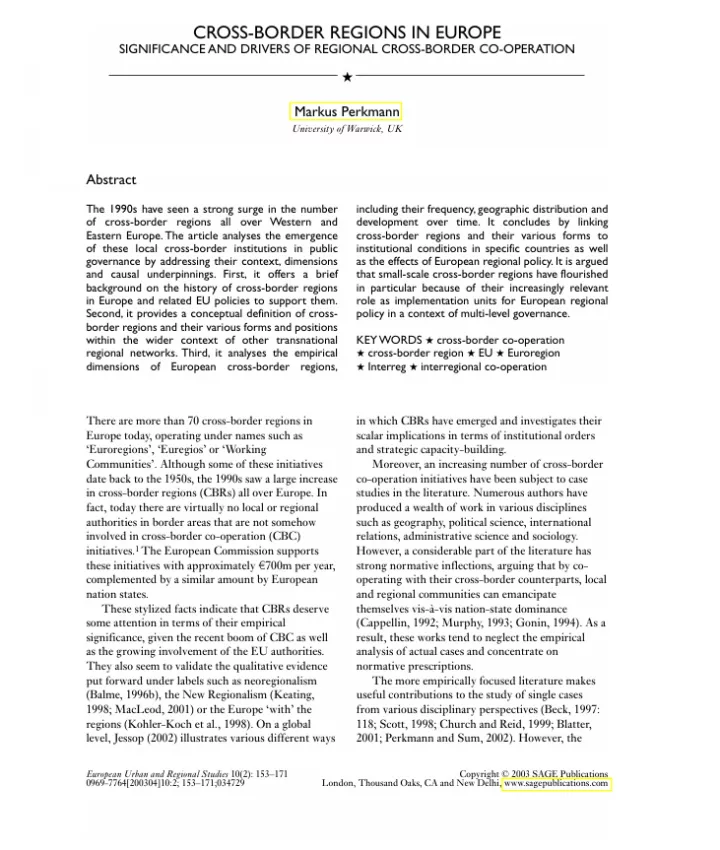
The 1990s have seen a strong surge in the number of cross-border regions all over Western and Eastern Europe. The article analyses the emergence of these local cross-border institutions in public governance by addressing their context, dimensions and causal underpinnings. First, it offers a brief background on the history of cross-border regions in Europe and related EU policies to support them. Second, it provides a conceptual definition of cross-border regions and their various forms and positions within the wider context of other transnational regional networks. Third, it analyses the empirical dimensions of European cross-border regions, including their frequency, geographic distribution and development over time. It concludes by linking cross-border regions and their various forms to institutional conditions in specific countries as well as the effects of European regional policy. It is argued that small-scale cross-border regions have flourished in particular because of their increasingly relevant role as implementation units for European regional policy in a context of multi-level governance.