Patients’ rights in cross-border healthcare in the European Union : report.
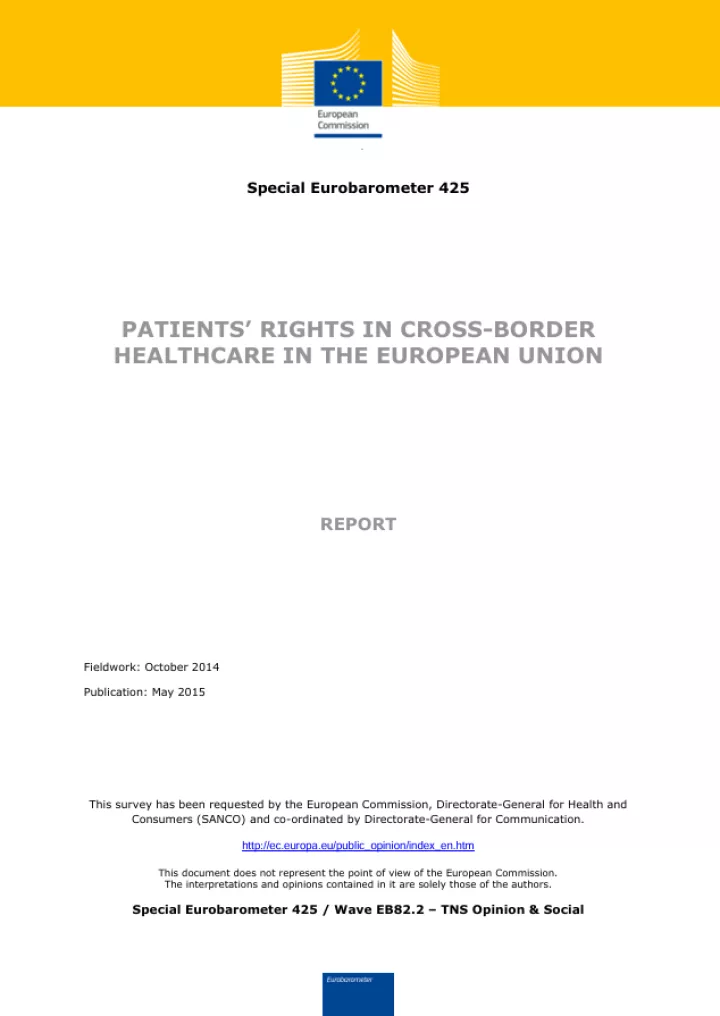
Patients’ rights in cross-border healthcare in the European Union : report.
Tipo:
Área geográfica:
Área temática:
Idioma:
Autor:
Directorate-General for Health and Food Safety, TNS Political & Social
Palavras-chave:
cross-border cooperation | European Union | free movement of persons | health care | health policy | opinion poll | organisation of health care | patient's rights | provision of services | report | sample survey | social security
Publication year:
2015
The provision of cross-border health services and their coverage by national healthcare systems is a highly complex process, still surrounded by legal uncertainties. In May 2007, a Flash Eurobarometer survey on "Cross-border health services in the EU" was conducted to find out how many people had actually received healthcare outside their country of residence, how aware they were of the possibilities for receiving healthcare abroad, and how willing they would be to receive medical treatment abroad and under what circumstances. No thorough research had been conducted since then. In 2011, a Directive proposed by the European Commission on the application of patients’ rights in cross-border healthcare was adopted by the European Parliament and the European Council. The objectives of this directive were to provide clear rules and reliable information to patients regarding access and reimbursement for healthcare received in another EU country, to meet patients' expectations of the highest quality healthcare when travelling abroad and to ensure EU countries work closer together in the interest of patients. On the 25th of October 2013, the directive came in to force in all EU Member States. Health Commissioner Tonio Borg said the following: "Today is an important day for patients across the European Union. As of today, EU law in force enshrines citizens' right to go to another EU country for treatment and get reimbursed for it (…). For patients, this Directive means empowerment: greater choice of healthcare, more information, easier recognition of prescriptions across-borders.” This new survey was commissioned as a follow-up to a similar survey conducted in 2007 in order to assess the situation of cross-border healthcare after the enforcement of the directive. It should be noted that this survey was conducted using the face-to-face methodology which is different from the methodology used in 2007 (telephone survey). Therefore comparison with the 2007 results should be taken with caution and are only indicative.